
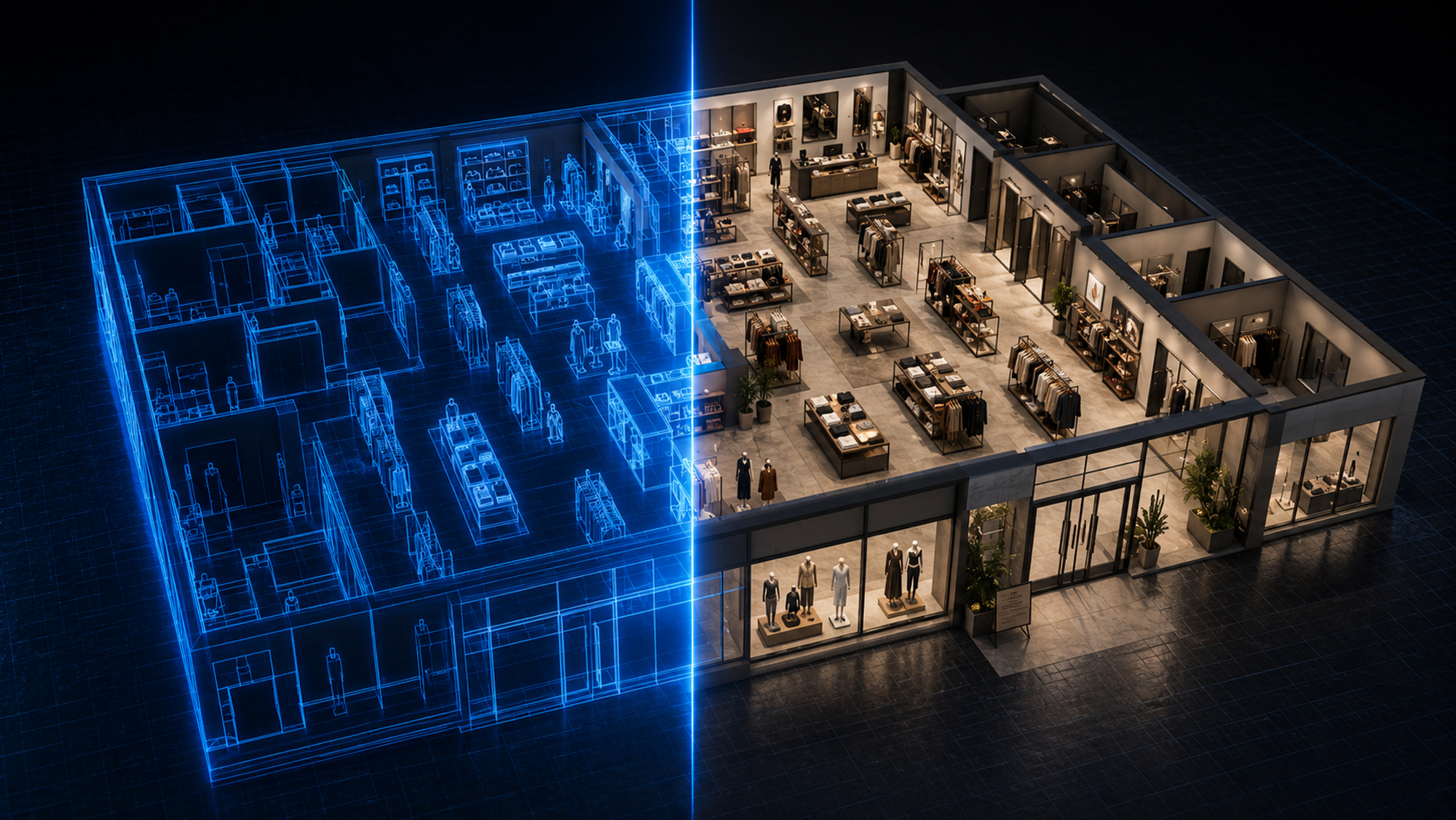
While Digital Twins are rapidly transforming marketing and commerce, their impact extends far beyond content creation. Digital Twins started in industries like aerospace, automotive, manufacturing, and infrastructure, where they have been powerful tools for simulation, operational monitoring, predictive analysis, and system optimization.
The concept is simple but incredibly powerful:
Create a connected digital representation of a physical object or environment, then use real-time data, simulation, and visualization to better understand how that system behaves over time.
What makes Digital Twins especially important today is the convergence of several technologies happening at once. From real-time rendering to cloud computing, IoT-connected devices, and increasingly advanced simulation systems, all leveraging the power of AI to accelerate testing and more accurately predict outcomes. Together, these technologies are transforming Digital Twins from static models into intelligent systems capable of continuously evolving alongside their physical counterparts.
In Manufacturing: Digital Twins can help teams simulate production workflows before physical implementation, reducing inefficiencies and identifying issues earlier in the process. They can also support factory layout optimization by allowing teams to test equipment placement, workflow routing, and operational efficiency before making costly physical changes.
In Aerospace and Automotive: Digital Twins support testing, predictive maintenance, operational monitoring, and performance optimization. These Digital Twins are regularly fed real-world data and conditions via their physical counterpart, allowing teams to identify issues earlier, improve system reliability, and make faster, more informed decisions throughout the product lifecycle.
In Retail: Digital Twins can be used to visualize showroom layouts, merchandising strategies, customer flow, and interactive retail experiences before deployment. Using insights generated from a digital twin, retailers can better understand customer movement throughout the store, help security teams identify high-risk areas, and implement theft prevention measures more effectively.
We understand Digital Twins are a part of a much larger shift toward connected digital experiences and intelligent product systems. As AI systems become more integrated with real-time data and simulation environments, Digital Twins may evolve into active decision-making systems capable of optimizing workflows, predicting outcomes, improving spatial planning, and dynamically adapting experiences.
What started as a way to mirror physical systems is quickly becoming a foundation for how organizations design, monitor, manufacture, and interact with the world around them.
Want to learn more?
Interested in exploring how Digital Twins can impact your organization? Connect with Magnetic to learn more about Digital Twin strategies and scalable, real-time experiences.