
I’m Lauren Sullivan, the new Account Director at Magnetic. I recently attended the Adobe Summit in Las Vegas with our CEO, Josh Diskin, where we had numerous goals and objectives. At the top of our list, to join the dialogue around the rising technology known as Digital Twins.
It wasn’t long ago that I was standing in my university Industrial Design studio, checking the masking tape on a rotating fan before slipping out to grab dinner. That tape connected the fan to my computer mouse by way of a chopstick, creating a very questionable but necessary system: as the fan turned, it kept the mouse moving just enough to prevent the computer from going to sleep during a seven-hour 3D rendering job in KeyShot.
If the mouse stopped, the computer slept. If the computer slept, the render failed. And if the render failed, seven hours disappeared with it.
But if I came back to a successful rendering waiting for me, it felt like a small victory worth celebrating…right before starting the next rendering job and doing it all over again for my final project.
The Keynote on Day 1 was hosted by Adobe CEO Shantanu Narayen, who was joined onstage by other global technology leaders, including none other than NVIDIA CEO Jensen Huang.
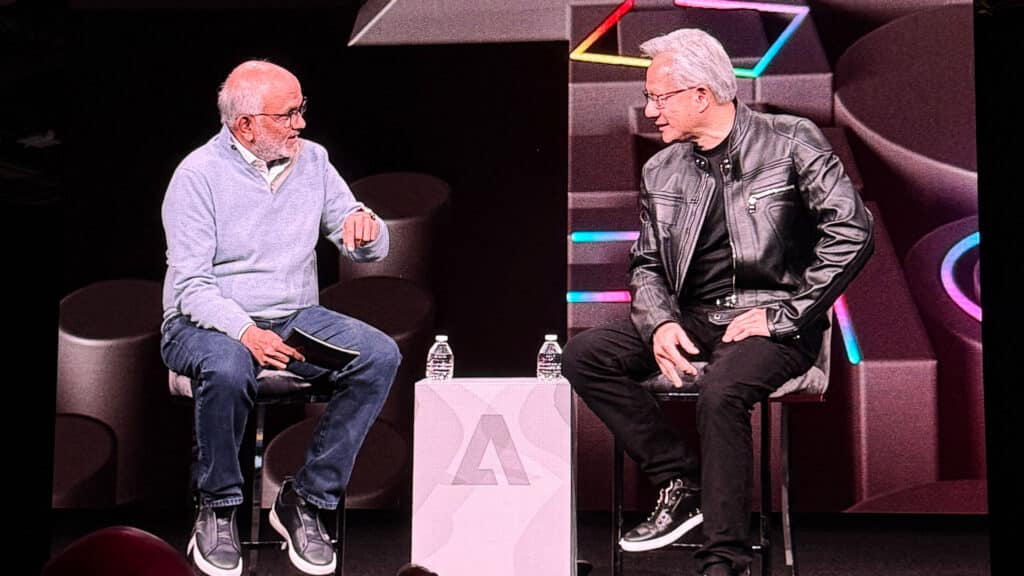
Very early into his time onstage, Mr. Huang mentioned the Omniverse and his excitement around creating Digital Twins of objects to be found inside that world; everything from perfume bottles to cars. He then started describing the benefits of AI assistance in creative efforts in general. In the past, companies were bound by the headcount of humans using Adobe software to create both products and the marketing for them. But considering how even just Creative Cloud comes with 20+ different programs, each with hundreds of tools, learning and using all of those tools is just not a realistic or even constructive effort for design teams. But now, Agentic AI empowers designers to access the full capabilities of the incredibly vast Adobe ecosystem and launch successfully faster than ever before.
But Agentic AI doesn’t stop at learning and employing efficient software use. It can also convert text into images behind the scenes in rendering tools, too.
Earlier that day I attended a session called, “Adobe Digital Twins: Making Every Product a Content Pipeline.” Each attendee was provided a desktop computer with a Firefly tab pulled up. For the next hour, we watched the speaker demonstrate how to articulate a 3D rendering of a coffee machine using Nodes. (For those unfamiliar, a Node is a functional unit or block within a visual programming system that performs specific calculations, transformations, or data generation.) Among these nodes were ways to edit the background and lighting for the final image. But perhaps the most important one was the Generative AI node powered by Firefly.
In this box, I typed a description of a background environment I wanted my coffee machine to appear in front of, describing the colors of the granite countertop and the decorative plants behind it.
I sat back in my seat to look at the array of nodes that would come together to generate not just images, but videos from cameras in eight different vantage points. I wondered how long it would take for such a complex system to finish rendering. At the bottom of the page, there was a blue button with the command “Run.” I clicked it, and watched the magic happen.
For even such a complex system as one with several different environmental factors, it only took a few minutes to generate multiple images and videos from multiple different angles. I couldn’t believe that something that required several hours and a hijacked rotating fan in college was now a smooth electronic brain processing at lightning speed.
When I’m not at a conference, I support Magnetic’s efforts to enter a bigger part of the market that builds APIs to make 3D rendering for Digital Twins possible too. It’s exciting to see how companies across luxury fashion and luxury automobiles are seeking ways to shorten the production timeline. The handoff of assets between departments is still tedious, but Digital Twins technology is eliminating those stresses in one motion.
Digital Twins may be new, but it’s not a secret anymore. When mingling with various people walking through the conference, I met marketing leaders from the fashion, automotive, and consumer goods industries already actively seeking Digital Twins opportunities. These introductions are all doors opening to opportunities and Magnetic is the exact helping hand they need to break into this new horizon.
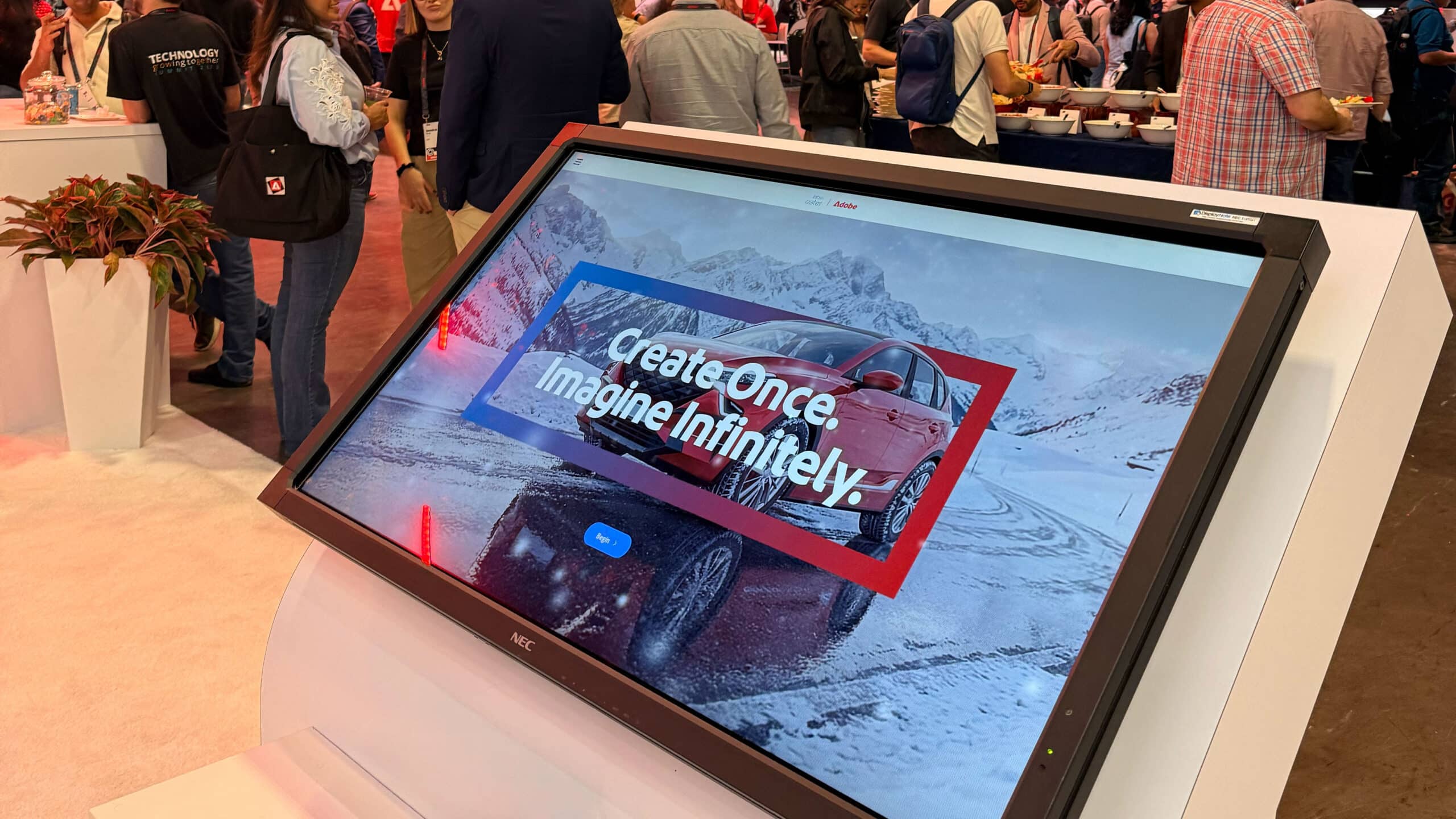
Before Adobe Summit wrapped up, I made sure to stop by the Infosys booth to watch the demo the Magnetic team helped build. The demo featured various angles of a 3D rendered red car. The most amazing part was that each angle was available to be previewed against completely different backgrounds. So even though the bright red car was technically the same rendering each time, it looked completely different up against the sunny desert environment than it did in the rainy city street at night. It was an incredible presentation of the capabilities that will soon be a major advantage in the industry.
As I look back on this week at Summit, I am left with a feeling of excitement and hunger for opportunity. What once took a sleepless college student, a spinning fan, and several anxious hours now happens in minutes with tools powerful enough to change entire industries. That shift is bigger than faster rendering; it represents a completely new way of thinking about design, collaboration, and how products come to life. Digital Twins are no longer a futuristic concept reserved for the biggest tech conversations; they are becoming the new standard for how brands create, market, and scale. Adobe Summit made it clear that this is only the beginning.
For companies willing to embrace it, the possibilities are limitless. And for teams like ours at Magnetic, we are always looking for ways to help organizations reach their goals in these areas. If your team is exploring what Digital Twins could mean for your operations, we’d love to hear from you.
– Lauren Sullivan, Account Director, Magnetic